What Your Toddler Is Actually Learning When You Hand Them a Shell
What Your Toddler Is Actually Learning When You Hand Them a Shell
10 new activity cards for Hunting Island — and why the beach is a better classroom than you think
There is a moment that happens on nearly every beach visit with a toddler. You are walking along the wrack line — that strip of shells and seaweed left behind by the last high tide — and your child stops. They crouch down. They pick something up.
You don't know what it is. They definitely don't know what it is. But they turn it over in their hands for a long time, running a thumb across a ridge, pressing it into their palm, holding it up to the light.
That moment has a name in early childhood development. It's called sensory-driven schema building — the way young children construct real knowledge about the world through their hands and bodies before their brains have words for it.
In other words: your toddler crouching over a shell is not wasting time. They are doing exactly what their nervous system needs to do, exactly when it needs to do it.
The problem is that most of us don't know what to say next.
"What is it?" is always the right question. You don't have to know the answer. Your job is to make space for the wondering.
10 New Cards Built for Exactly That Moment
The newest additions to the Roots & Rainboots activity card series — Cards 22 through 31 — were designed specifically for Hunting Island State Park and the barrier island ecosystem found along South Carolina's southern coast.
Each card is a small, two-sided guide for caregivers. One side shows what to look for. The other tells you what to say, what your child is building developmentally, and one simple thing to try together. No background knowledge required. No special equipment. Just you, your child, and whatever the barrier island puts in front of you that day.
Here's a look at five of them.
Card 22 — Sea Turtle Nesting
Loggerhead sea turtles nest on South Carolina beaches between May and August. Most families walk right past a nest site without knowing it's there — a roped-off section of sand with a small wooden marker doesn't look like much.
This card teaches children what a nest site looks like, why we give it a wide berth, and what will happen inside that sand if everything goes well. It introduces the word "stewardship" through action rather than lecture: we don't go closer because something wild is counting on us not to.
What they're building: Scientific observation, cause-and-effect reasoning, early environmental ethics.
Card 23 — Alligators at the Marsh Edge
Before you close this tab — stay with me.
This card is actually a regulation activity dressed up as a wildlife encounter. The alligator is real, yes. The observation happens from a safe distance, yes. But what the card is really asking your child to do is practice stillness — quiet feet, slow breath, a body held still long enough to watch something wild do what it does.
For children ages two through five, that kind of intentional stillness is genuinely hard work. It requires self-regulation, patience, and the ability to hold a feeling of excitement without acting on it immediately. The alligator is the invitation. The regulation is the point.
What they're building: Emotional regulation, impulse control, sustained attention.
Card 25 — Ghost Crab Burrows
Ghost crabs are fast — fast enough that most toddlers will never get a good look at one before it disappears. This card redirects the attention from the crab itself to the evidence it leaves behind: the burrow.
What shape is the opening? How wide? Can you find more than one? Is the sand around it different from the sand nearby? These are the questions real field naturalists ask. They are also the questions that build early scientific thinking in children who are two, three, and four years old.
What they're building: Observation skills, deductive reasoning, scientific vocabulary.
Card 26 — Maritime Forest Listening Walk
This one requires nothing except a willingness to slow down.
The maritime forest at Hunting Island — live oaks twisted by saltwater wind, Spanish moss overhead, palmetto fronds clicking in the breeze — has a distinct acoustic environment. This card asks you and your child to stop walking, sit down, and listen for sixty seconds.
For a toddler, sixty seconds of intentional quiet is a genuine challenge and a genuine accomplishment. You can build up to it over several visits. The goal isn't silence — it's attention. What did you hear that surprised you?
What they're building: Auditory discrimination, capacity for stillness, sensory attunement.
Card 27 — Shell Study: Shape and Texture
South Carolina's state shell is the lettered olive — a smooth, cream-colored cylinder with brown zigzag markings that looks, when you hold it, like someone wrote on it with a fine brush. Most children who pick one up have no idea what it is. Most adults don't either.
This card names it. It also names the knobbed whelk, the lightning whelk, and the Atlantic cockle — four shells common to Hunting Island's wrack line, each with a distinct texture and shape that makes them ideal for sorting, comparing, and talking about.
You don't need to be at the beach. A handful of shells in a bowl on the kitchen table does the same work. The names are what matter — because a child who knows the name of the thing in their hand is a child beginning to feel at home in the natural world.
What they're building: Vocabulary, fine motor discrimination, classification skills.
You Don't Need to Be at Hunting Island
Every card in this series was designed with Hunting Island in mind — but none of them require you to be there to use them.
The observation skills, the regulation sequences, the language prompts — they work at any beach, any coastal park, any shoreline your family has access to. The shell card works with shells from your last vacation still sitting in a jar on the windowsill. The listening walk card works in your backyard. The alligator card works anywhere your child encounters wildlife that requires stillness and respect.
What makes these cards place-based isn't that they only work in one place. It's that they were built from close attention to one real ecosystem — and that specificity is what makes them feel different from generic activity guides. The details are real. The species are real. The language on the card is the language a naturalist would actually use, scaled down to what a three-year-old can hold.
A child who knows the name of the thing in their hand is beginning to feel at home in the natural world. That sense of belonging is what we're building.
What Caregivers Actually Need
One of the things I hear most from parents and grandparents is some version of this: I want to do more outside with my child, but I don't know what to say or do out there. I'm not a naturalist. I didn't grow up learning the names of things.
That's exactly what these cards are for.
You don't need to know the difference between a knobbed whelk and a lightning whelk before you hand your child Card 27. The card tells you. You don't need to have studied child development to know when to be quiet and when to ask a question. The card tells you that too.
The adult's job in all of this is simpler than most people think. It is to be present. To slow down when the child slows down. To say the name of the thing. To ask "what do you notice?" and then actually wait for the answer.
That is enough. That is, in fact, a lot.
The Full Series
Cards 22 through 31 cover ten distinct features of the Hunting Island barrier island ecosystem:
- Card 22 — Sea Turtle Nesting
- Card 23 — Alligators at the Marsh Edge
- Card 24 — The Tidal Wrack Line
- Card 25 — Ghost Crab Burrows
- Card 26 — Maritime Forest Listening Walk
- Card 27 — Shell Study: Shape and Texture
- Card 28 — Storm-Shaped Trees / The Boneyard
- Card 29 — The Intertidal Zone
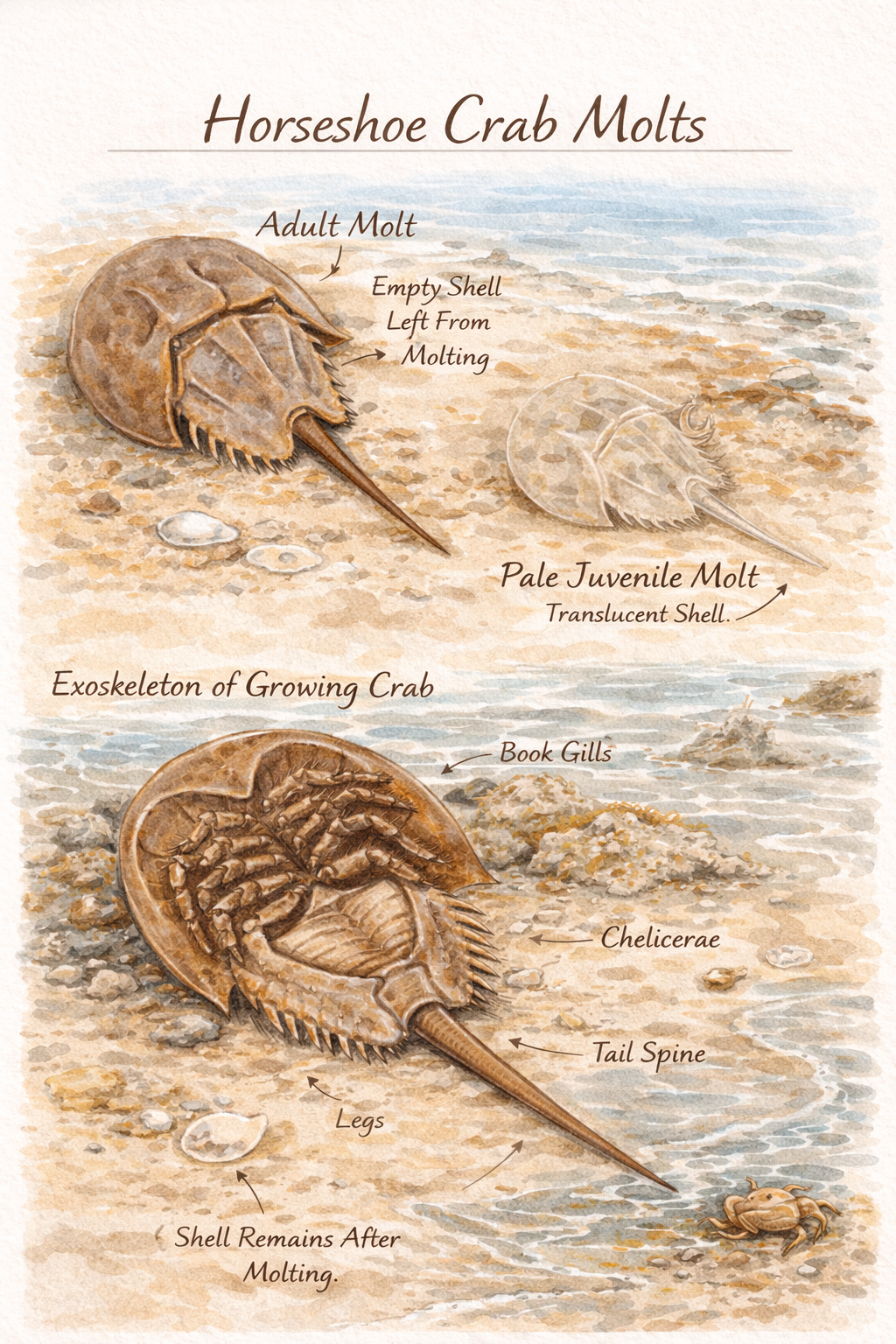
- Card 30 — Horseshoe Crab Molts
- Card 31 — Pelican Watch
All cards follow the same format: What to Look For, How to Explore, Language to Use, Parent Tip, Season, What They're Learning, and a safety note where relevant. Two-sided, 4.5 by 6.5 inches, built to survive a beach bag.
They are available individually and as a complete Hunting Island set at rootsrainboots.com.
— Tamara Founder, Roots & Rainboots Nature Co. Forest School Teacher Certificate — FSTI, endorsed by Southern Adventist University MSEd in Outdoor Education Seasonal interpretive staff · Hunting Island, Edisto Island, Devils Fork State Parks
© 2026 Roots & Rainboots Nature Co. · rootsrainboots.com