Walking Under Something Ancient
ROOTS & RAINBOOTS NATURE CO.
Walking Under Something Ancient
What I didn’t know about live oak — and what it means to walk under a tree that
was alive before you were born.
Field Notes from Hunting Island · Maritime Forest Trail
I knew live oak the way you know a landmark.
The sprawling canopy. The Spanish moss. The way the branches grow sideways as much as
up, reaching out over the trail like something deliberate. I had walked under these trees at
Hunting Island dozens of times and registered them as scenery — beautiful, present,
unremarkable in the way that only the most common things become unremarkable.
Then I started actually looking at them.
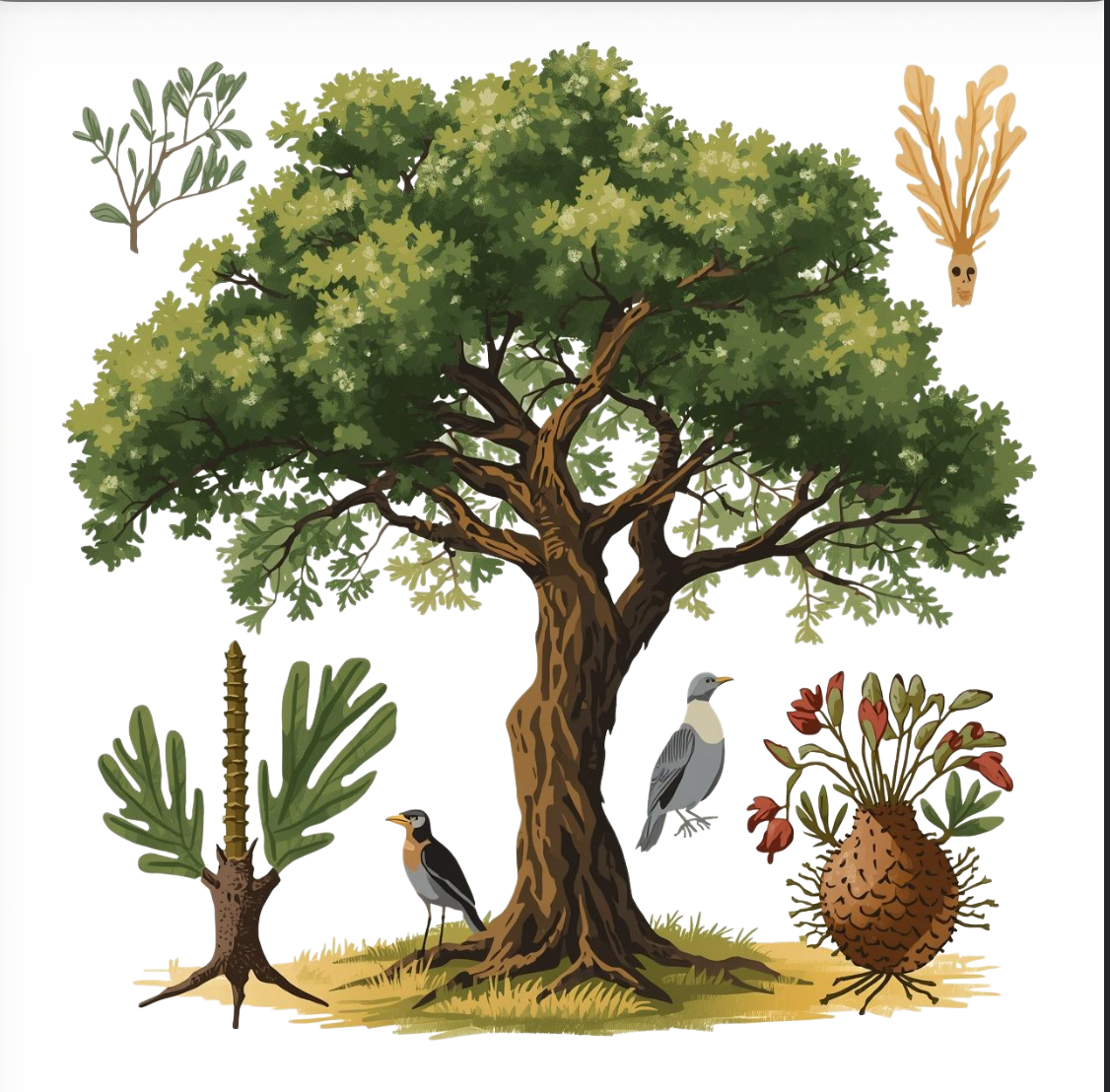
A live oak can live for 500 years or more. The trees lining the forest
trail at Hunting Island may have been standing when the first
European ships appeared on this coastline. They were here for every
hurricane, every king tide, every summer that has ever passed over
this island.
The name “live” oak comes from the fact that it keeps its leaves through winter — unlike
most oaks, which drop their leaves in fall. In the Lowcountry, that means the maritime
forest stays green year-round, the canopy intact, the understory shaded even in January. The
tree is technically semi-evergreen, swapping old leaves for new ones in spring rather than
going bare.
What grows on the live oak is almost as interesting as the tree itself. Spanish moss — which
is neither Spanish nor moss, but a bromeliad related to the pineapple — hangs from the
branches in long silver-gray curtains, collecting moisture from the air. Resurrection fern
grows flat against the bark, turns brown and appears completely dead in dry weather, then
unfurls green within hours of rain. Both are epiphytes: they use the tree for structure but
take nothing from it. The live oak hosts them without cost.
The wood of the live oak is extraordinarily dense — denser than most hardwoods, resistant
to rot and salt air. It was used to build the hull of the USS Constitution, the oldest
commissioned warship still afloat in the United States. In the War of 1812, British
cannonballs reportedly bounced off her hull, earning her the nickname “Old Ironsides.”
That hull was live oak from the Carolina coast.
I walk under these trees differently now. Not faster, not with more information running in
my head — but with more awareness of what I’m walking under. Something that has been
here longer than anyone alive. Something that will, if left alone, be here long after.
— Tamara
Roots & Rainboots Nature Co.
Certified Forest School Teacher (FSTI) · Shorebird Steward, Audubon SC · Camp Host
rootsrainboots@gmail.com · Field Notes from Hunting Island