Not One Thing, But Two
ROOTS & RAINBOOTS NATURE CO.
Not One Thing, But Two
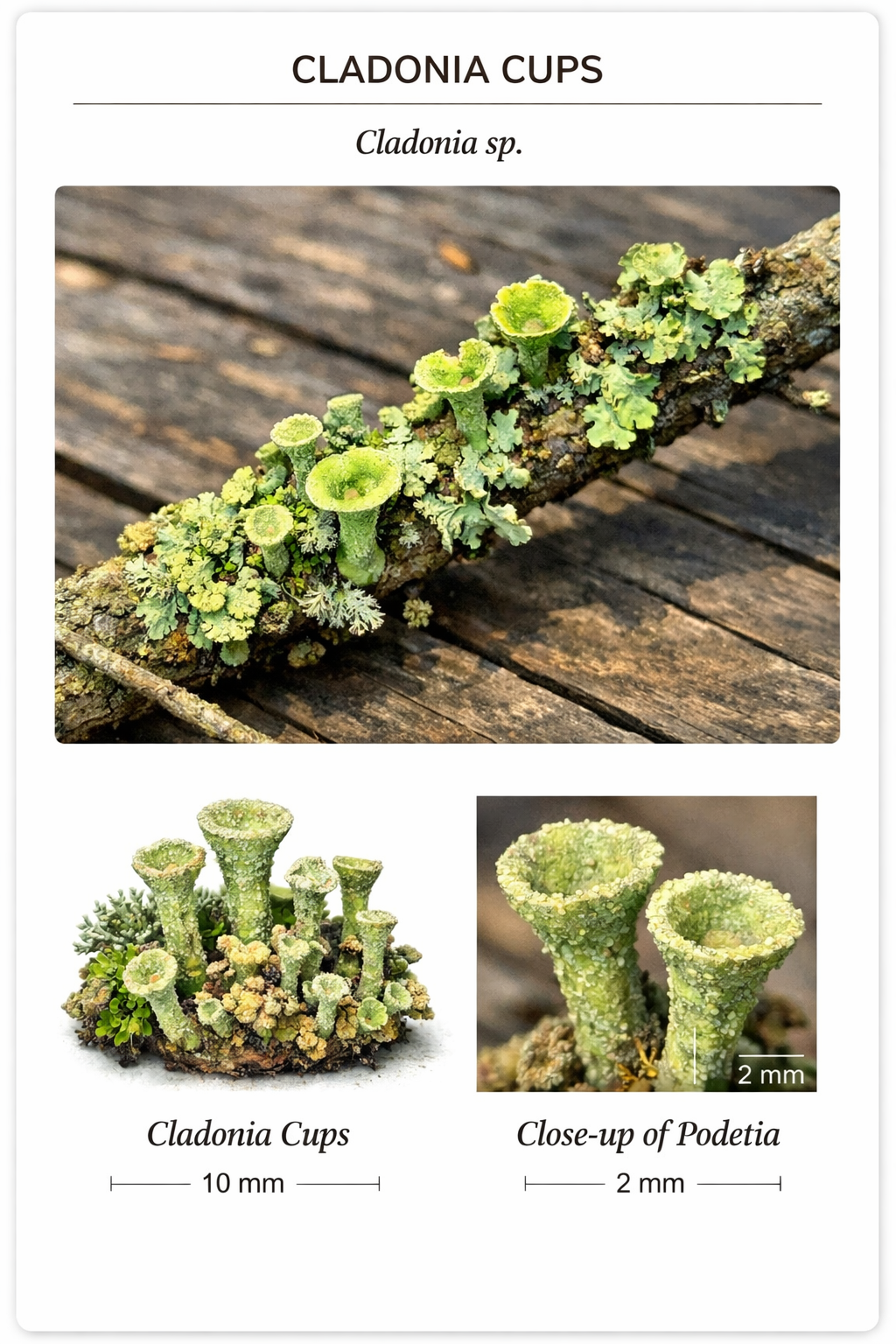
A fallen branch, a forest floor, and what I thought I already knew about lichen. Field Notes from Hunting Island · Forest Floor · Fallen Branch I knew what lichen was. Or I thought I did. That gray-green crust on old headstones and fence posts. The flat patches on rocks. I had always registered it as background — the thing that grows on things, slow and unremarkable, part of the scenery you stop seeing. Then I found a fallen branch on the forest floor at Hunting Island covered in something I couldn't look away from. Ruffled lobes of pale green, layered like tiny cabbages, with small cup-shaped structures rising from the surface. It looked like a miniature landscape. It looked alive in a way the flat gray patches never had. When I looked it up I learned something that rearranged the way I see the natural world: lichen is not one organism. It is two — a fungus and an alga — living so completely intertwined that for centuries scientists classified them as a single plant. The fungus builds the structure — the lobes, the cups, the body. The alga lives inside it, photosynthesizing, turning light into food that feeds them both. Neither could survive in that form alone. Together they have colonized every continent on Earth, including Antarctica. They grow on bare rock, on desert sand, at the tops of mountains. They are among the oldest living things you will ever touch. Those cup-shaped structures I noticed — they're called apothecia. They're the lichen's reproductive bodies, releasing spores into the air to start new colonies on new surfaces. The rootsrainboots@gmail.com · Field Notes from Hunting Island ROOTS & RAINBOOTS NATURE CO. lichen I was holding had probably been growing on that branch for years before it fell. It would keep growing now that it had. Lichen is also one of the best indicators of air quality we have. Many species are extraordinarily sensitive to pollution — they vanish from cities and industrial areas and thrive where the air is clean. Finding this much healthy lichen at Hunting Island tells you something about the place itself. The forest is speaking, if you know what to listen for. I have walked past lichen my entire life and called it background. I won't anymore.
— Tamara Roots & Rainboots Nature Co. Certified Forest School Teacher (FSTI) · Shorebird Steward, Audubon SC · Camp Host rootsrainboots@gmail.com · Field Notes from Hunting Island