Use quiet eyes
Look first for movement, patterns, colors, and changes in the sand.
The card opens the door. The child decides what happens next.
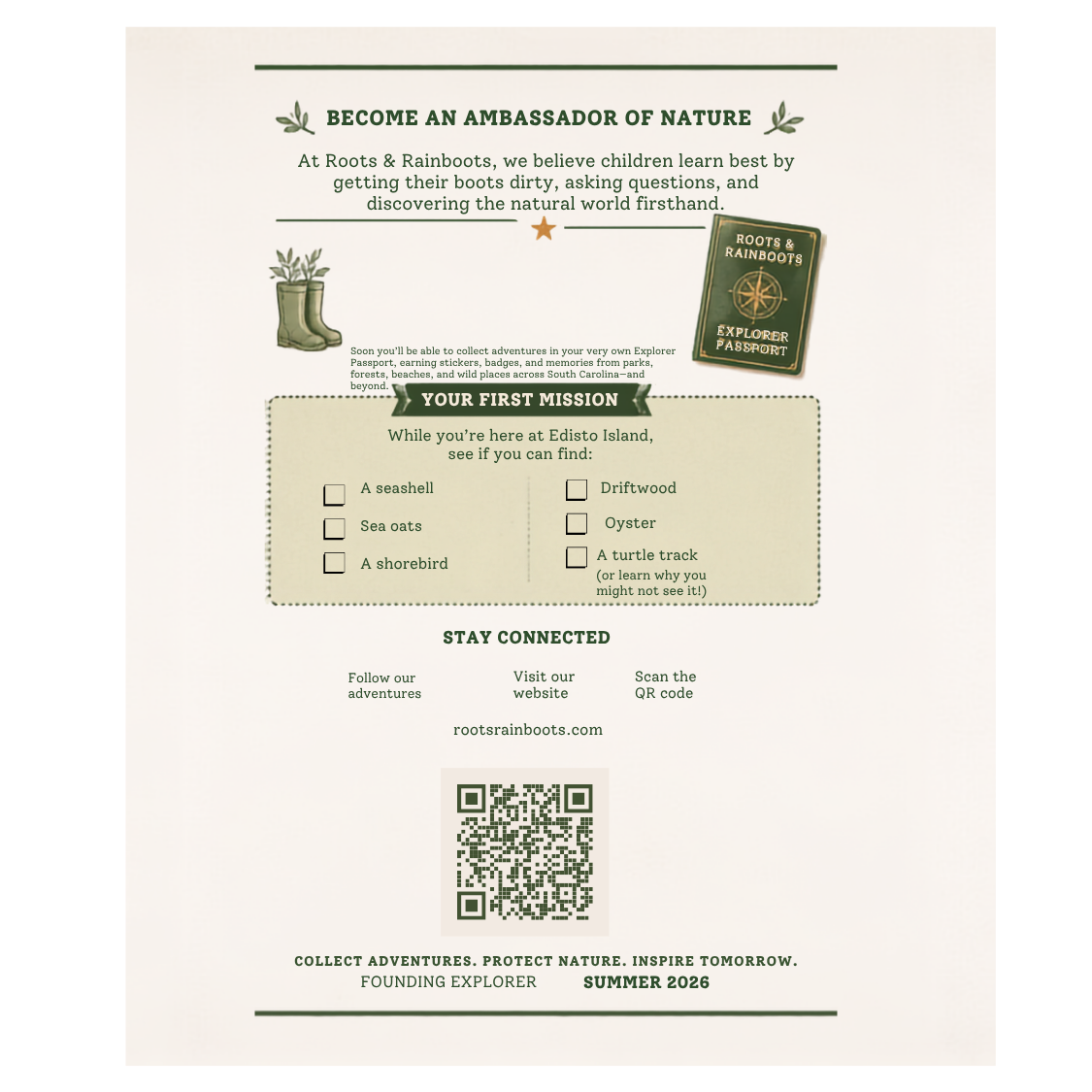
It represents curiosity, care, and the promise to leave room for the wild things that share this place.
Your first mission
There is no need to collect or disturb anything. Point, sketch, photograph, or simply remember what you notice.
Mission complete? Choose one discovery to tell someone about.
Look first for movement, patterns, colors, and changes in the sand.
Questions are field tools. You do not need to know the answer yet.
Carry out what you bring in and give wildlife plenty of room.
October at Edisto
Fall migration is active on the South Carolina coast. Shorebirds, raptors, and monarch butterflies are all moving through Edisto this month. Here is what is here, and where to find it.
Start at the wrack line — the long strip of debris the last high tide sorted and left behind. Look before you touch: shells, seaweed, feathers, driftwood, crab molts, sea glass, and occasionally a mermaid's purse (the leathery black case that held a skate's eggs). Everything in that line traveled on the water to get here.
For shells: scallops have fan-shaped ridges; cockles are round with a smooth, bowl-like interior; oysters are rough and gray-blue. A cream-colored shell with brown zigzag markings is the Lettered Olive — South Carolina's state shell. If you find a flat, round disk with a star pattern, that's a sand dollar. A dark or fuzzy one is still alive and goes back to the water.
Above the high-tide line, look for small round holes in the dry sand — about the width of two fingers, sometimes with a mound of sand beside them. That's a ghost crab burrow. Crouch down and wait. Sometimes one will peek out.
Step off the beach and stop walking. Close your eyes and count the sounds: woodpecker drumming in the live oaks, cicadas, palmetto fronds clicking in the breeze, waves muffled through the trees. Hold up one finger for each different sound. This is one of the most useful things you can do with a child at a noisy park.
Look at the trees facing the beach. Their branches grow only on the inland side — salt spray prunes the seaward growth back until the whole canopy leans like a weather vane. Spanish moss is not a parasite. It pulls moisture and nutrients from the air and does the tree no harm.
At low tide, fiddler crabs work the exposed mud flat near the campground and park road — males wave one oversized claw to communicate. Watch from a distance and the flat comes alive. Look for the American Oystercatcher along the waterline: bright orange beak, hard to miss, uses it to pry open shells.
Scan the water's edge for a dark, log-like shape that isn't moving. That's an alligator. Look for the eye ridge — two small bumps just above the surface. Stay back (ten times the animal's length is the rule), and watch without speaking for 60 seconds. A calm body sees more here.
In October, osprey are migrating south along the coastline — watch for them hovering, then diving feet-first. Brown pelicans fly in low formation just above the wave crests. Find one and count five slow breaths while you watch. That's the whole activity.
More park guides at rootsrainboots.com
Keep exploring. This is only the beginning.